

Gallery Silver Scpaes
Untitled
Untitled
Couldn't load pickup availability
Medium: Oil on canvas
Size: 40 x 30 inches
Year: 1979
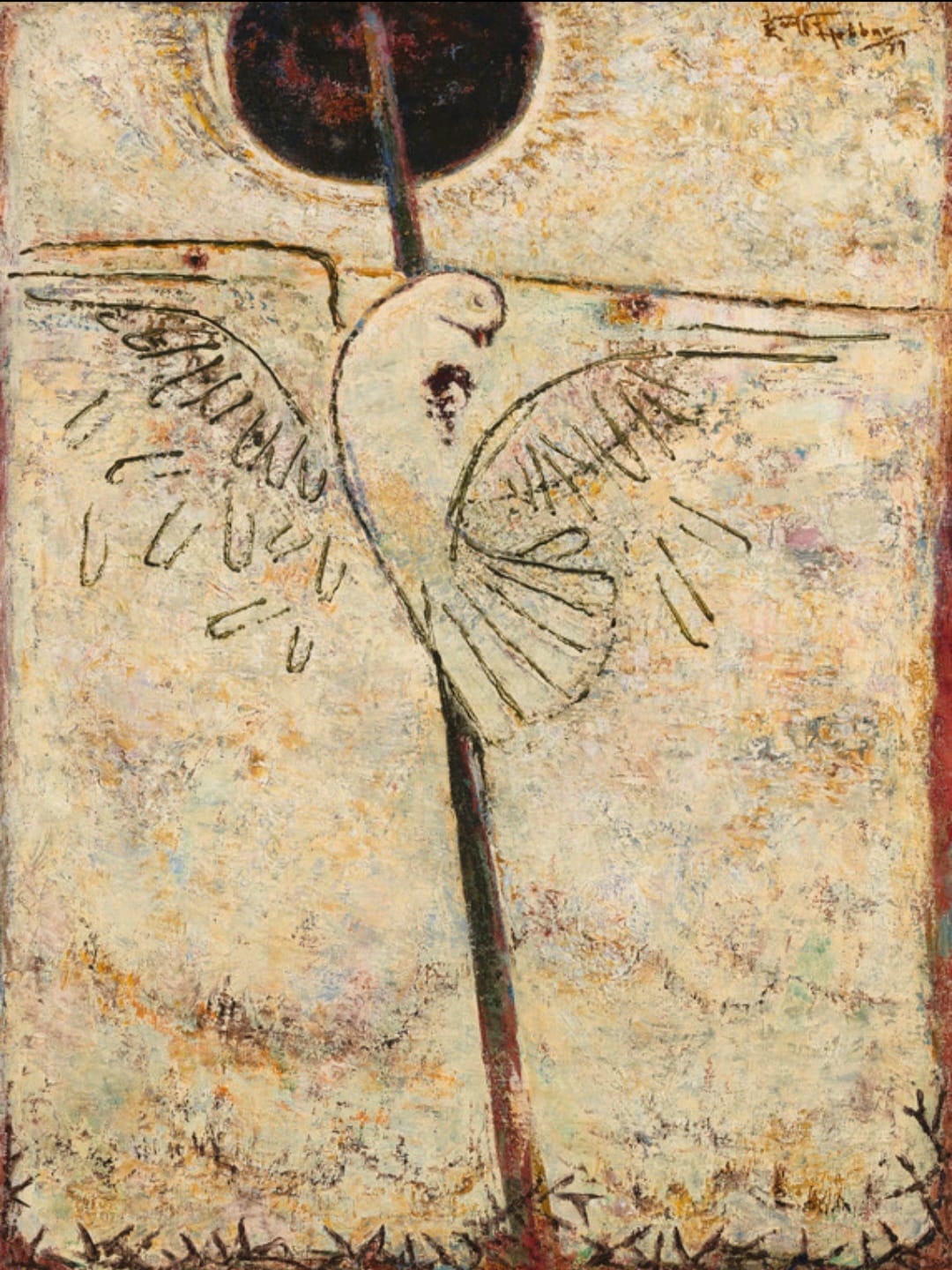
The present work was painted in 1979, a year after K. K. Hebbar was appointed President of the Lalit Kala Akademi, Karnataka. This period marked a crucial moment in the artist’s career, when he produced a series of paintings reflecting on the lingering impact of the 1971 Bangladesh Liberation War. The broader socio-political atmosphere in India was similarly charged, as the country emerged from the Emergency period, a time that deeply influenced Hebbar’s reflections on freedom, humanity, and renewal.
In this evocative composition, Hebbar reinterprets the image of the crucified dove as a metaphor for the resilience of peace after conflict. The bird, its wings outstretched in a gesture of ascent, symbolizes regeneration, the triumph of harmony over adversity. Rising above a field edged with barbed wire, it appears to ascend toward a radiant sun, suggesting the dawn of a new era. While the dove universally signifies peace, its treatment here reveals Hebbar’s profound humanism and moral sensitivity. As K. G. Subramanyan observed, Hebbar’s works often “romanticized a scene and gave it a visionary air… coloured by a passion that was painless, that carried no shout of revolt but a sense of compassion.” (Hebbar: An Artist’s Quest, NGMA, 2011, p.16). Conceptually and stylistically, the work represents Hebbar’s mature phase, marked by a shift toward greater abstraction. Here, the narrative yields to a symbolic and meditative image, what Veena K. Thimmaiah describes as the balance between “the representational, the metaphysical, the suggestive and symbolic.” (KK Hebbar Beats & Counterbeats, NGMA, 2011, p.27). The painting embodies Hebbar’s pursuit of “inner satisfaction,” achieved through an integration of abstraction, texture, and spiritual reflection.
Executed in his characteristic oil technique, the work demonstrates Hebbar’s mastery of layered pigment and surface modulation. Employing a titanium white base, he built up and scraped down layers of paint, producing a nuanced texture that animates the surface with quiet energy. As V. R. Amberkar observed, Hebbar’s compositions evolved toward “colour orchestration,” where shaded passages became expressive zones of light and tone rather than mere modeling (Lalit Kala Akademi, p.3). This work epitomizes Hebbar’s artistic and philosophical vision, his conviction that art must communicate through both form and feeling, transforming lived experience into a timeless meditation on renewal and the enduring aspiration for peace.

Why Choose Us
Art has always, naturally, reflected the development and exploration of different thoughts and perceptions, and our current postmodern era is no different. It is interesting to see how art has evolved visually, yet the traditional methods of composing art remain a valid means of expression.
All it takes for an artist to rise above normalcy, is inspiration, which fuels his passion to paint beautiful creations throughout his life.
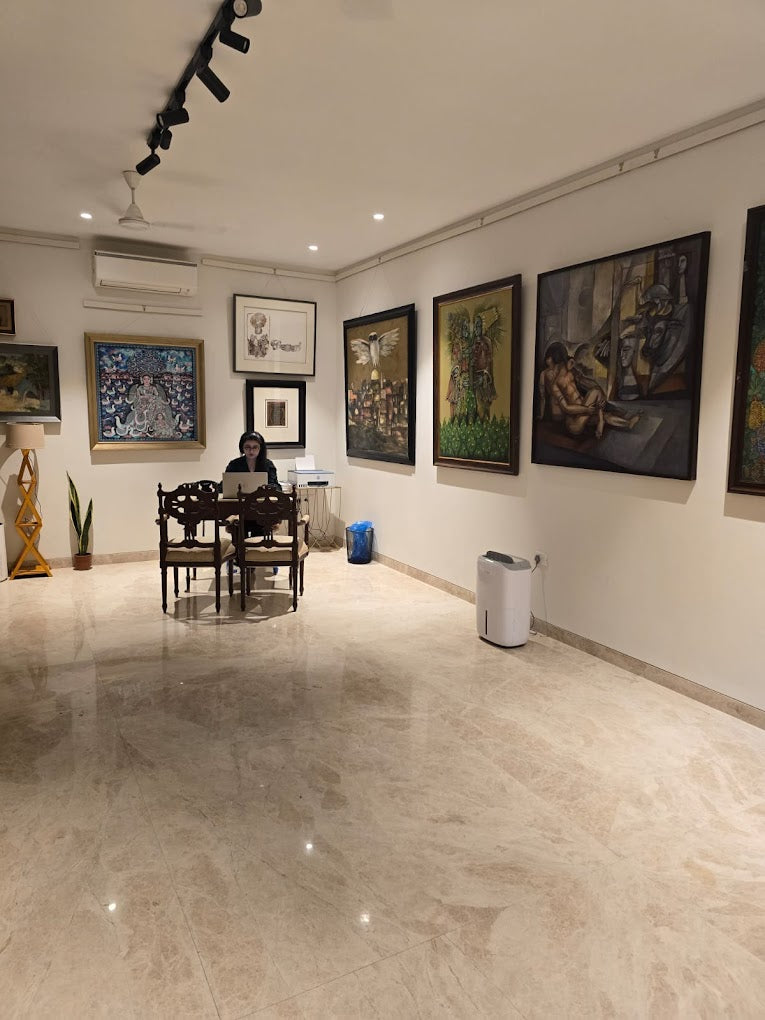
The valuable expression of art is always there with us, but now this expression is yet to take an interesting diversion with our art gallery, Gallery Silver Scapes, located in Hauz Khas Enclave. Art is no longer considered just decorative but has evolved and come forth as a major form of investment yielding high rates of returns for its buyers, making it an expression commonly used.
Mrs Mayor was walked into the art world by the legendary modernist Bimal Das Gupta, one of whose biggest collections remains with Gallery Silver Scapes. In the 1980s, as head and first curator of the Habiart Gallery founded by Mrs Rekha Modi — a childhood friend — Mrs Mayor worked closely with and curated shows for renowned artists such as A Ramachandran, GR Santosh, Rameshwar Broota, Sakti Burman, MK Bardhan, Dhiraj Chaudhury, M Sivanesan, and Arup Das among others.
Besides modern masters, she also worked with young contemporaries such as Sudip Roy, Paresh Maity, Subroto Kundu, Vinod Sharma, and many more. Artworks commissioned by her are now part of prestigious collections, such as those of the India Habitat Centre, Ranbaxy, Pepsi, Hotel Lalit, Bank of America, and many more private and public collections.